A few weeks ago, Simcha Even-Chen returned from a three-month residency at the Yingge Ceramics Museum in Taiwan. She agreed to answer a few questions to share her experience and present the pieces she created on this occasion.
Located on the outskirts of Taipei, Yingge has a history spanning nearly 200 years linked to functional pottery, particularly objects used during the tea ceremony (teapots, tea bowls). Nowadays, the town remains Taiwan’s largest ceramics production centre. Chosen by the Yingge Ceramics Museum from among 89 international artists, Simcha Even-Chen was able to immerse herself in this unique environment as part of a three-month artistic residency between May and July 2024.
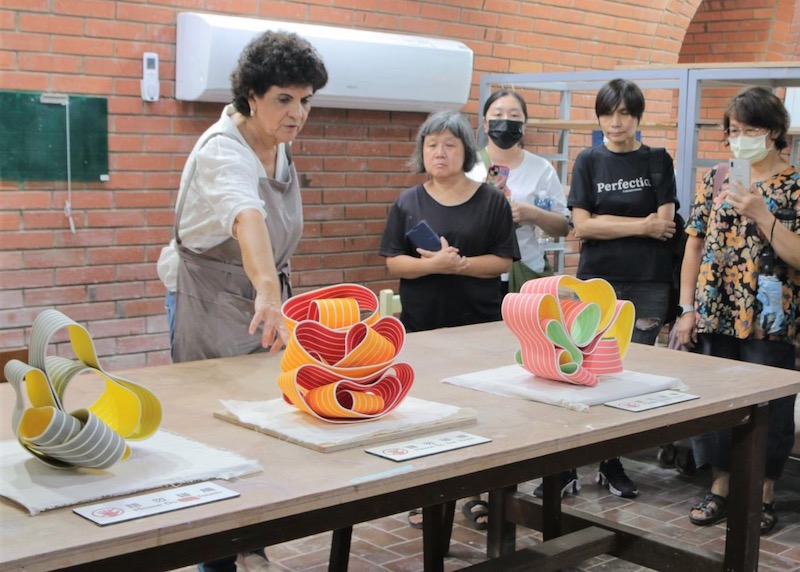
What motivated you to apply to this residency programme?
As a member of the International Academy of Ceramics (IAC), in 2018 I attended a conference in Taipei and discovered the Yingge Ceramics Museum where works by members of the IAC were exhibited. The museum was opened in 2000 to preserve the town’s cultural legacy, while instilling new energy into the area. The residency programme was established to encourage both local and international ceramic artists to come and experience life in the pottery town through a short-term residency. This programme is well known and it is not easy to be selected! The selection committee is made up of experts, scholars and museum representatives.
For me, doing a residency in another country gives me the opportunity to continue my research on porcelain clay and colour, experimenting with local resources. Working with different materials, in a different studio and surroundings forces you to leave your comfort zone and be more focused and creative, which generates innovative ideas.
During your residency, you had the opportunity to meet three other ceramic artists also taking part in this residency programme. What did you enjoy most about this experience? Is it something that will potentially influence your work? More generally, do you prefer to work alone or in contact with other artists?
That’s right, I was not alone during the three-month residency. Two other artists from Greece and Japan were there as well. Three weeks before I left, another artist from India/Russia joined the programme. Meeting artists from different countries and cultures around the world and sharing knowledge and ideas is extremely stimulating and fruitful for me. I do not think it will influence my work, but it is always interesting to see different ways of working, techniques and ideas. You always learn something new.
Generally, I prefer to work alone. In the residency, each of the artists has their own space, but you can still communicate and follow the others’ work.
You also had the opportunity to interact with local students and artists. What was their reaction to your work?
During my residency, I visited different local artists’ studios and was exposed to different techniques. In parallel, part of my duties as an artist-in-residence was to give a workshop or demonstration to students and local artists. In my case, since my process is complicated, I gave a demonstration and a lecture.
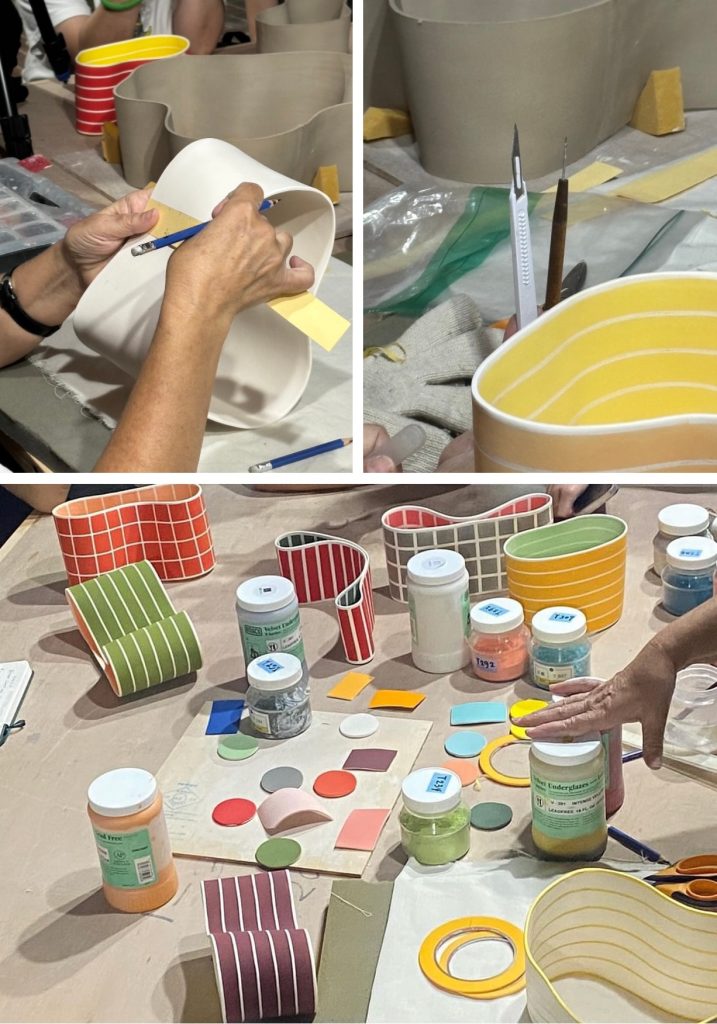
Porcelain is characterised by its thinness, fragility, transparency and whiteness, but my work does not explore these features. Since 2017, my research has been focused on the collapsing properties of a wide variety of porcelain clay brands, trying to determine the “physical collapsing limits” of each one, to obtain new amorphic, organic and free forms without cracking. The students and artists were surprised by the thinness of my pieces. They could not figure out how I was going to create a sculpture from all the prepared elements. My way of thinking and working and the technique I have developed all seemed unusual to them.
Has this experience enabled you to identify and explore new ideas or possibilities in relation to your own research into colour? I’m thinking of the way that colours are perceived in Asia, their symbolism and meaning, which are very different from the Western vision.
Part of my research is interested in people’s reaction to colours. Colour is a powerful communication tool linked to humans and their emotional psychology, reflecting their way of acting and their worldview.
Since this was not my first residency or travels in Asia, I was already aware of how some colours are perceived and their symbolism and meaning in Asia. Red is linked to joy and happiness, blue to stability and security, yellow is reserved for royalty, green is a symbol of fertility, and black represents strength and authority, etc.
During the residency, I tested many colours and colour combinations. It was interesting to see the viewers’ reaction to the colours, regardless of their culture and the colours’ symbolism. Their reaction was always unique to the individual.
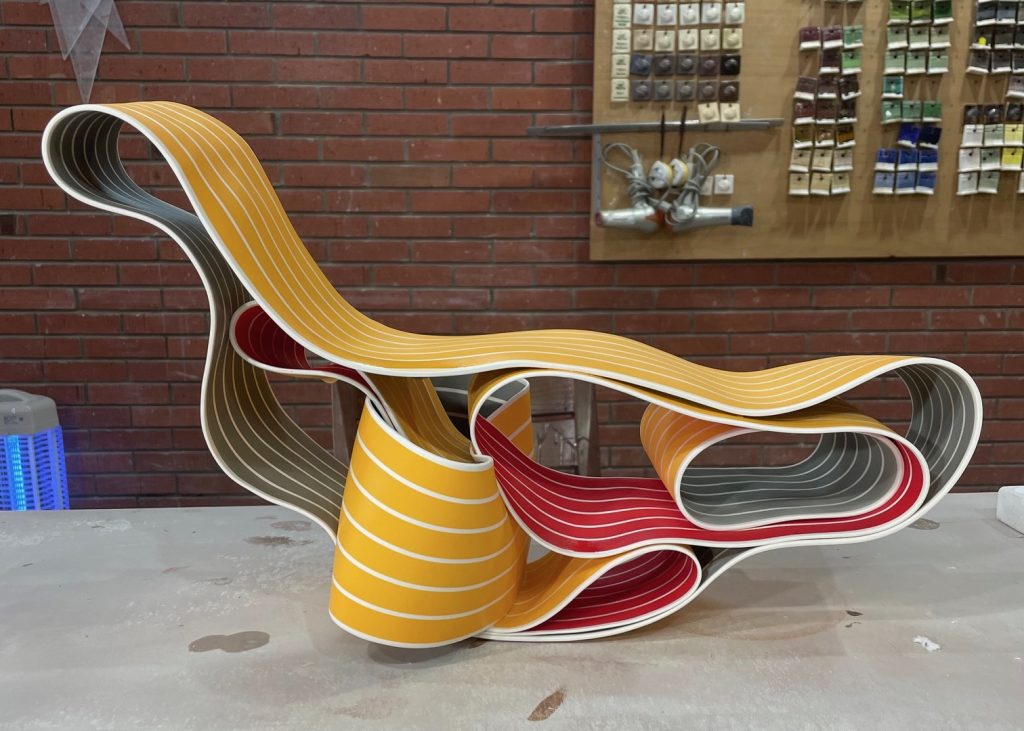
During this residency, you developed a new series that you had begun before your departure. Can you tell us a little more about this series and the pieces you created at Yingge?
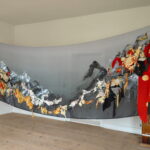
Before coming to the residency, I started working on a new series of sculptures called “Integrated Inside / Outside”. In this series, I use different colours applied to the inside and outside of the pieces. When they collapse, there is an integration between the inside and outside of the sculpture’s elements, creating new colour combinations. During my residency, I had the opportunity to continue developing this series. As the porcelain I used (Japanese Porcelain 31) was different and new to me (I had never used it before), the collapsing results were different from those in my studio, resulting in differently shaped final sculptures.
When I’m assembling the sculpture, I must take the size of the kiln into consideration. The kilns available at the residency studio were too big or smaller than mine, so I had to figure out a new way of assembling the elements, which created a new sculpture. In the last two sculptures, I tried using three colours. The results were interesting, and I will continue experimenting with this line of sculpture.
I managed to prepare five sculptures during the residency period.
Do you already have other residencies planned?
My next residency is scheduled for September – November 2025 at Taoxichuan Ceramic Art Avenue, Jingdezhen, China.