Until 28 June 2026, the Musée Massey in Tarbes presents the “Calo Carratalá, the Feeling of Landscape” exhibition. Through some thirty works — paintings, drawings, and travel notebooks — the exhibition explores how the Valencian artist transforms his immersions in the natural world into inner landscapes. Between tropical forests and snow-covered peaks, his painting, attentive to nuance and to the memory of travel, invites us to look at nature in a different way.
At the Musée Massey in Tarbes, the “Calo Carratalá, the Feeling of Landscape” exhibition offers an introduction to the work of a Spanish painter who, for more than thirty years, has devoted his practice to the exploration of landscape. Trained at the Faculty of Fine Arts in Valencia (Spain), Calo Carratalá has, since the early 1990s, developed an approach deeply rooted in travel and in direct observation of nature.
The exhibition’s curator, Véronique Renaudot, has brought together around thirty works — paintings, drawings and sketches — centred on two key themes in the artist’s recent production: the forest and mountains. The exhibition unfolds across three spaces in the museum and guides visitors from Amazonian landscapes to the mountain ranges of the Alps and the Pyrenees.
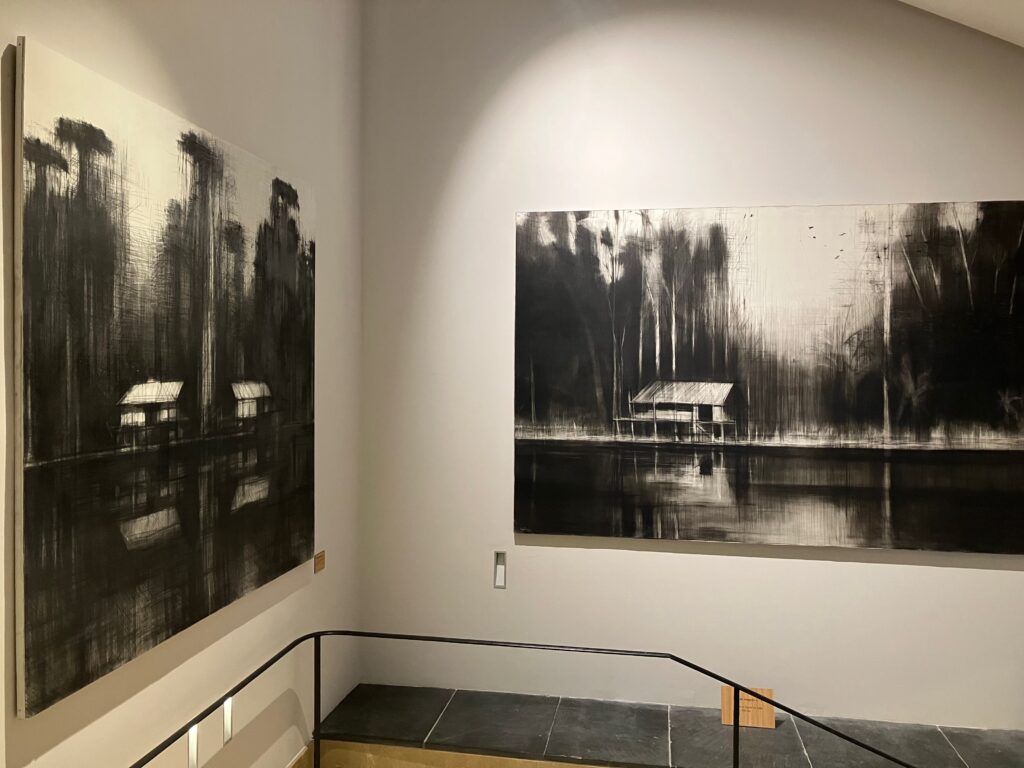
The visit begins in the museum’s stairwell, where two monumental works in pencil and charcoal depict landscapes observed from the Amazon River. Their imposing dimensions — up to three metres wide — immediately convey the ambition of the project: to translate the power of natural environments that far exceed the human scale.
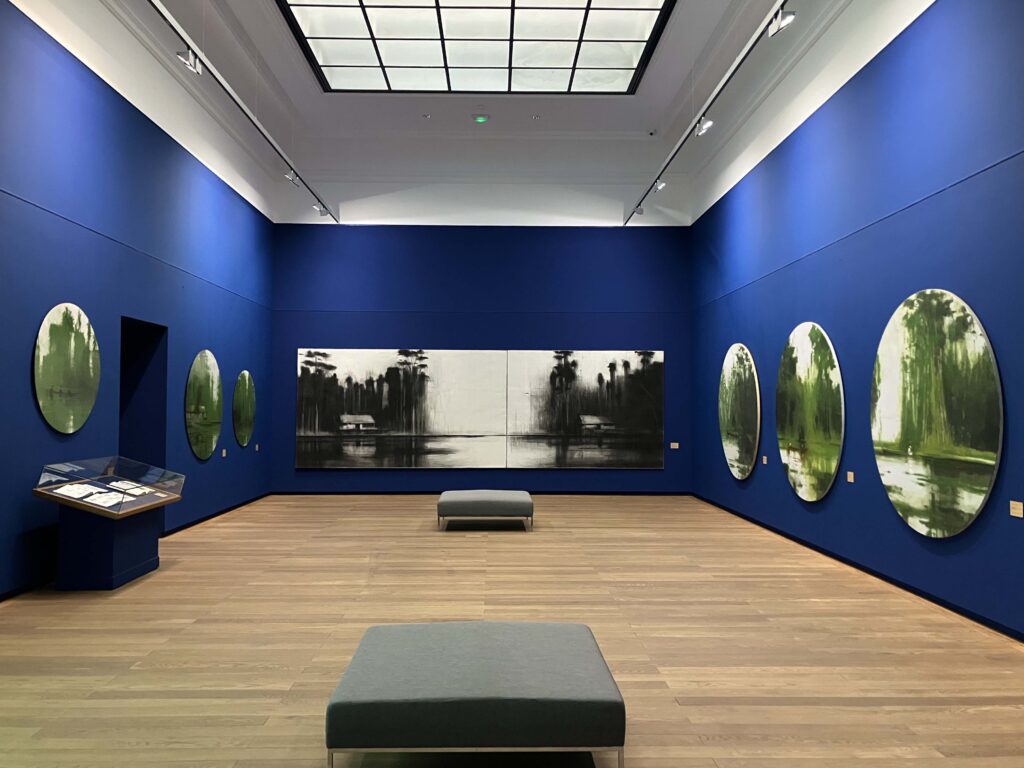
Upstairs, the room on the right focuses on mountain landscapes. The Pyrenees and the Alps appear through large-scale canvases, as well as drawings and pages from travel notebooks. The room on the left then leads visitors toward more distant regions: the Amazon rainforest and landscapes in Tanzania. The transition from one room to another is also marked by a clear shift in colour. The whites and greys of snowy landscapes give way to the deep greens of tropical vegetation.

The diversity of works on display, in terms of both technique and medium, directly reflects the artist’s working method. During his travels, Carratalá produces sketches, watercolours, and visual notes “sur le motif”. This practice recalls that of nineteenth-century painters who worked directly in the landscape. Once back in Valencia, the artist allows this material to mature for several months before using it to develop large-scale compositions. These canvases then become recollections of the places he has experienced.
The text accompanying the exhibition highlights this inner dimension of the work: “Calo Carratalá is not a naturalistic artist, nor a ‘painter of reality.’ The energy that fuels his creation is introspective in nature; it is at once emotional, instinctive, and intellectual. The images Carratalá brings to life on the canvas are not faithful representations of what the eye perceives ‘photographically’. They are eruptions of the artist’s inner life, which he offers to our own introspection and meditation.”

In these landscapes, often devoid of human presence — or inhabited only by tiny silhouettes — nature appears both majestic and fragile. When figures do appear, they seem almost engulfed by the density of the forest.
The strength of Carratalá’s works also lies in their economy of means. “In certain series, his reduced palette borders on monochromy. This work on nuance and wash drawing strongly recalls the ink paintings of the great Chinese masters […] of philosophical landscape painting”, the exhibition text also notes. Far from impoverishing the image, this chromatic restraint heightens the intensity of the atmospheres.
By bringing together monumental works and fragments of travel notebooks, “Calo Carratalá, the Feeling of Landscape” sheds light on a body of work that constantly oscillates between observation and memory. The exhibition thus offers an illuminating entry into the universe of an artist for whom landscape is never merely a place, but a sensitive and meditative experience.
Calo Carratalá, the Feeling of Landscape
Massey Museum, Rue Achille Jubinal, Tarbes, France
The exhibition continues until 28 June 2026