Presented at Mitsuko Castle, the exhibition “継 (TSUGU) – Woven Time” by Japanese artist Maho Maeda (28 March – 26 April 2026) explores memory, transmission and time through a series of works made from fragments of antique kimonos. Combining textiles, painting, and assemblage, the artist reflects on how traces of the past are reconfigured in the present. We interviewed the artist to learn more about this exhibition.
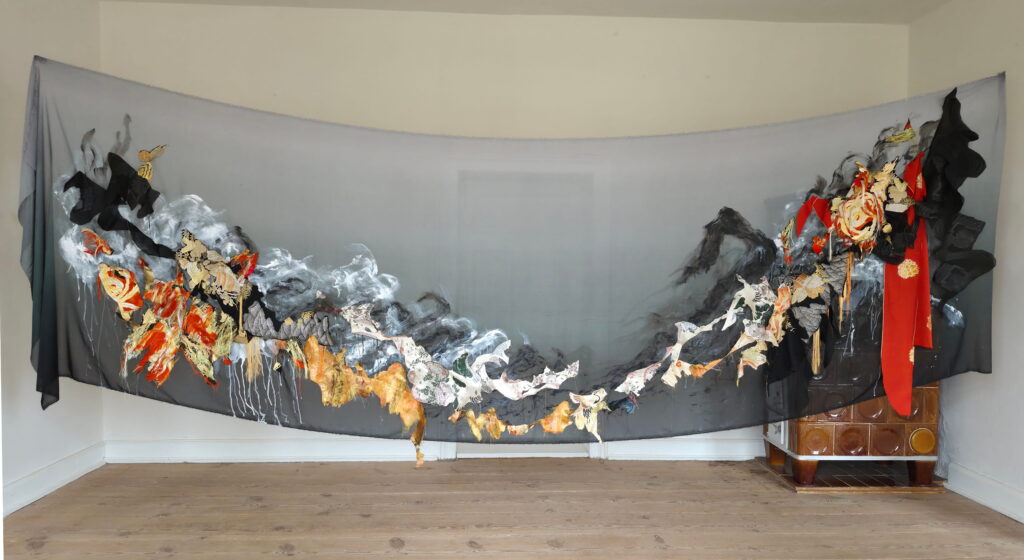
In TSUGU / Woven Time, Maho Maeda presents a body of work rooted in antique kimonos –some over a hundred years old – revealing the hidden layers they contain. Deconstructed, fragmented and reassembled, these textiles are not treated as simple materials, but as carriers of memory: the gestures that made them, the bodies that wore them, and the lives they once accompanied. Through a process that combines fabric, thread, painting and drawing, the artist creates new relationships between fragments, giving form to a non-linear sense of time shaped by overlapping and continuity.
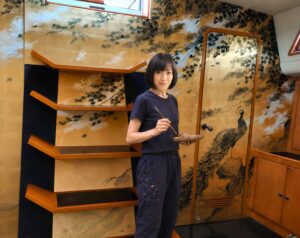
This approach is partly grounded in personal experience: her childhood in Japan was marked by the presence of her grandmother, a kimono maker. The memory of her careful, repetitive gestures fostered a deep sensitivity to both the materiality of fabric and the time it holds. Now based in Mexico, after studying in Europe, Maeda brings this intimate memory into a broader perspective, where cultural heritage, geographical movement and contemporary practice intersect.
On the occasion of this exhibition, she reflects on the central role of the kimono in her work, her process of transforming materials, and the ways her pieces seek to connect past, present and future.
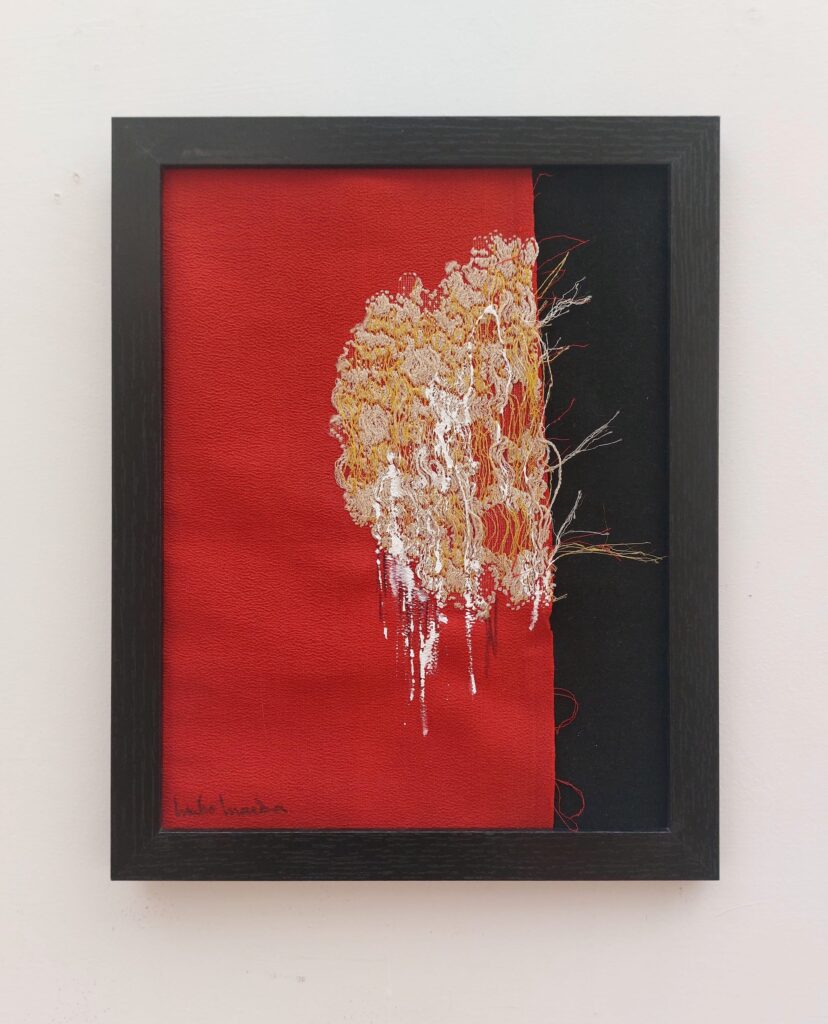
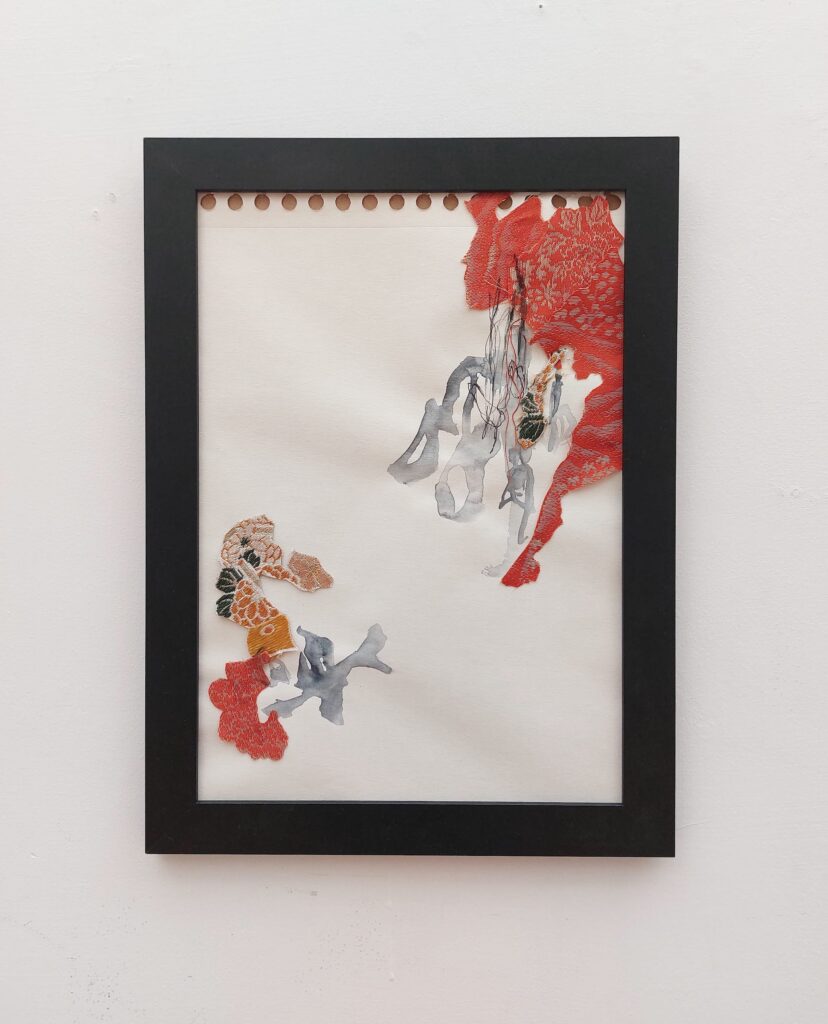
Can you explain the title of this exhibition: “継 (TSUGU) – Woven Time”?
Maho Maeda: The Japanese word “tsugu (継)” carries several layered meanings: to connect, to inherit, to restore, and to weave together. Through the works in this exhibition, I wanted to explore how fragments of memory, material, and time overlap and are carried forward from the past into the present and into the future; not as a linear flow, but as something formed through their interweaving.
Connecting past and present, the inheritance of time, memory and history: these are the central themes of this exhibition.
The kimono is very present in this exhibition, both as fragments inside the works and sometimes as a base. What made you choose this material, and what does it mean in your work?
Maho Maeda: All of the kimonos I use in my work are very old, and each one was once owned by someone. Some are over a hundred years old. So, within the works, they are not simply fabric, but materials that already carry time and memory. Someone made them, someone purchased them, someone wore them, someone stored them away, and ultimately they found their way to me. Those traces are present in each one. For me, these kimonos are a medium where personal memory and cultural memory overlap.
Most of the kimonos that have come into my hands are too old or too damaged to be worn anymore. But with a conscious awareness of carrying their time forward, and with deep respect for all that time they hold, I bring them into my work, hoping that a dialogue will emerge between what has been inherited and my own lines and colours.
The kimono has a personal meaning for you, connected to your grandmother when you were a child. Can you tell us more about this?
Maho Maeda: My grandmother was a kimono maker. Traditional kimonos are sewn entirely by hand, and she would sit on the floor of a small room, day after day, needle in hand. She once seriously injured herself when a needle pierced her hand while she was working, and because of that, we grandchildren were not allowed to enter her workroom.
Even as a child, I was always drawn to that space: with fabric scattered everywhere, it seemed like a place full of treasures. But I never wanted to disturb her while she worked, so I would watch her quietly from behind, her back bent over her sewing. Her movements were so still, yet there was a quiet dignity to them, and from that age I always felt a deep respect for her.
That memory has stayed with me ever since. When I think of kimonos, I think of her. I believe those experiences have shaped the way I relate to fabric, and the way I perceive time. And when I work with cloth in my pieces, the particular atmosphere of her workroom and the rhythm of her sewing naturally rise up within me, finding their way, quietly, into the work itself.
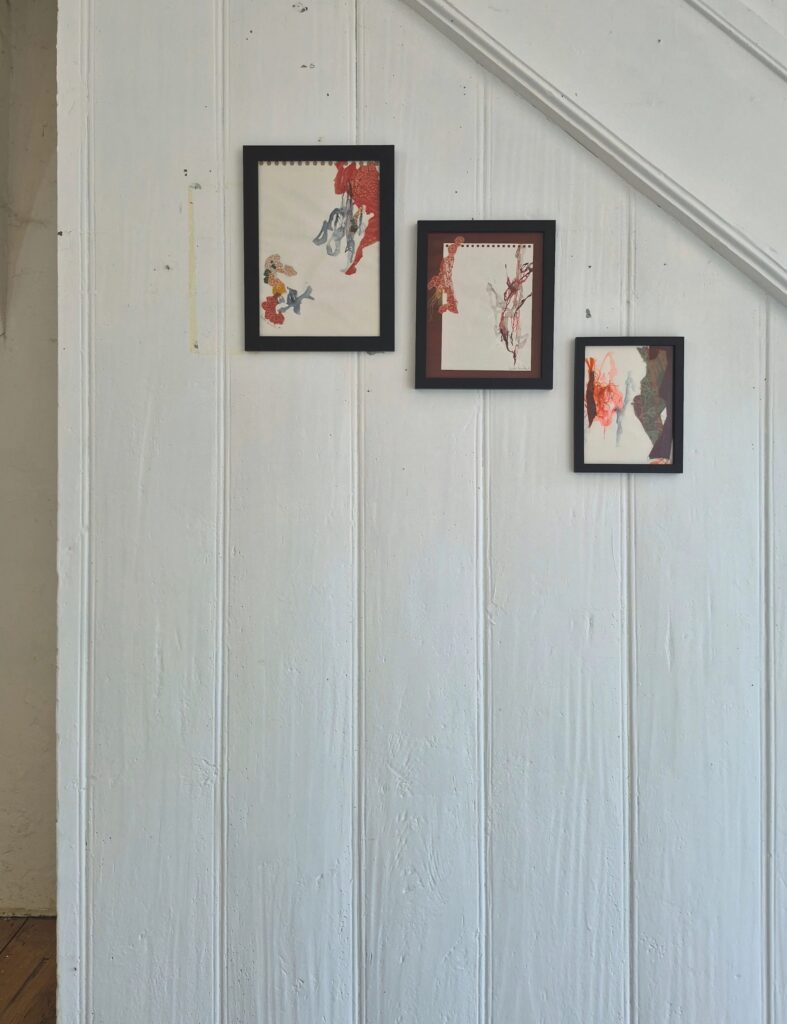
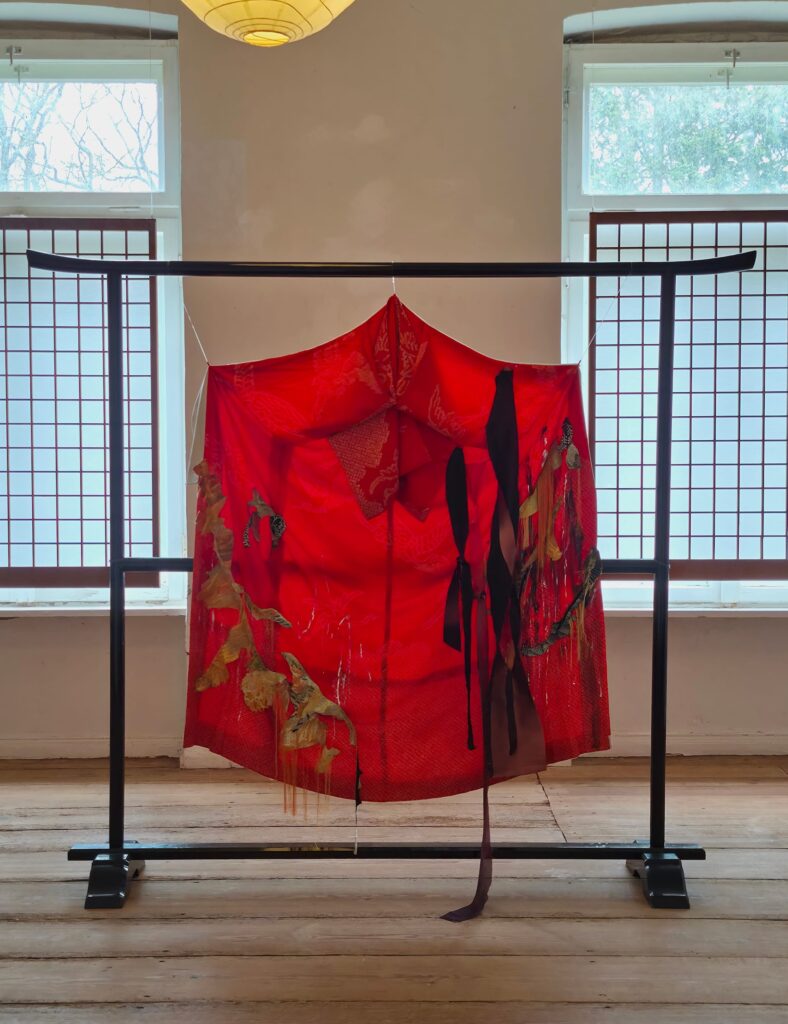
In your works, kimonos are cut, transformed, sometimes reduced to loose threads, and combined with painting-like elements. What does this process of transformation mean for you?
Maho Maeda: Whenever I deconstruct a kimono or an obi, I always do so with a sense of reverence for its presence and the time it carries, yet the process never quite loses its tension. But for me, it is an essential endeavour for drawing out new layers of time and meaning.
In taking them apart, I begin to see the immense amount of work the craftspeople put into them: the time that went into every stitch, the remarkable skill beneath the surface. Hidden elements that could never be seen in the finished form are revealed. By bringing those parts into the light, a new perspective emerges. And so every element that went into their making, down to a single thread, feels precious and significant to me.
Through fragmentation, the time and structure embedded in the materials become more clearly visible. And by recomposing them within a work, new relationships emerge. It also becomes a process of questioning, once again, the relationship between past and present.
You were born in Japan, studied in Europe, and now live in Mexico. How does this experience between different cultures influence the way you think and create?
Maho Maeda: Living across different cultures has given me a perspective from which I can question my own assumptions and values, seeing them not as set truths, but as one of many ways of understanding the world. I now approach things through multiple lenses rather than a single, fixed view.
At the same time, living within other cultures has made me newly aware of the richness of my own, the things I had simply taken for granted while growing up in Japan. Seeing it from the outside has made me more conscious of its subtlety and distinctiveness, and it has brought me to feel a natural sense of pride in where I come from.
That is precisely why I want to hold my own sensibility and experience as a Japanese person at the core of who I am, and to express that clearly through my work.
Maho Maeda: “継 (TSUGU) – Woven Time”
28 March – 26 April 2026
Deutsches Japanmuseum | Museum für zeitgenössische Kunst – Schloss Mitsuko
Thürkow, Germany – japanmuseum.de