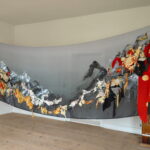
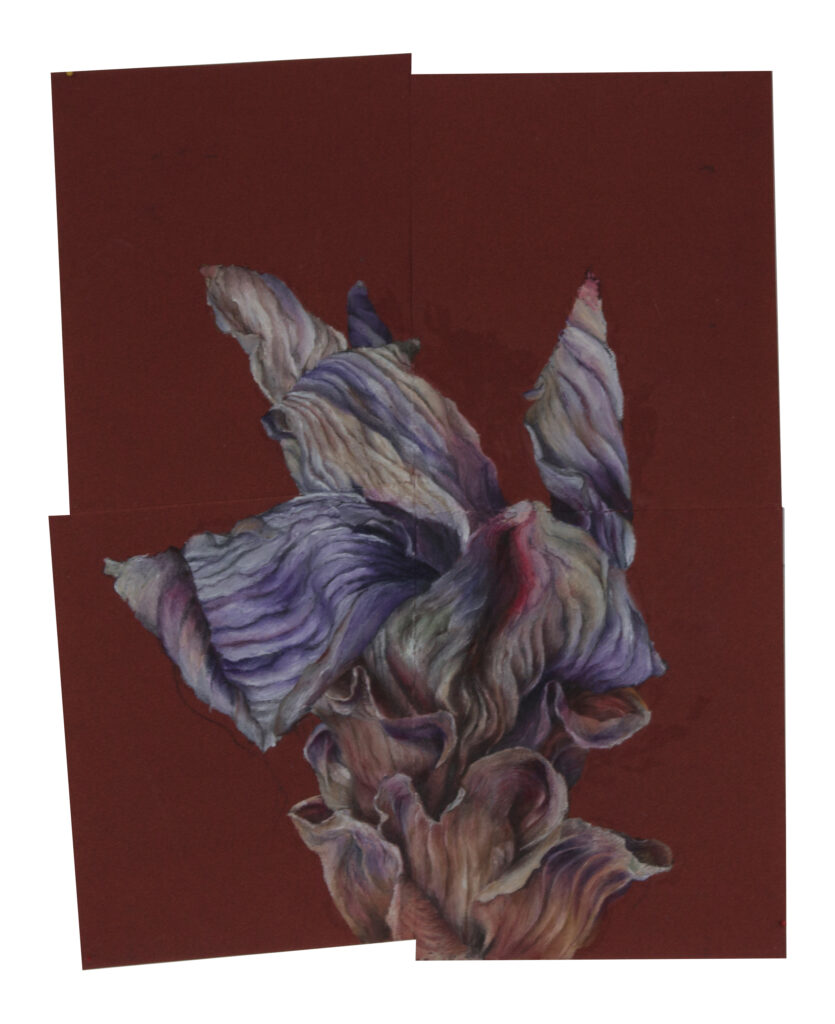
Human-sized flowers, captured at the moment they begin to fade, unfold across dark red sandpaper in Sharon Brill’s latest paintings. In this striking new series, the artist reflects on cycles of collapse and renewal, and on the experience of maturing as a woman. Even before the works were shown to the public for the first time, she agreed to share the story behind them with us.
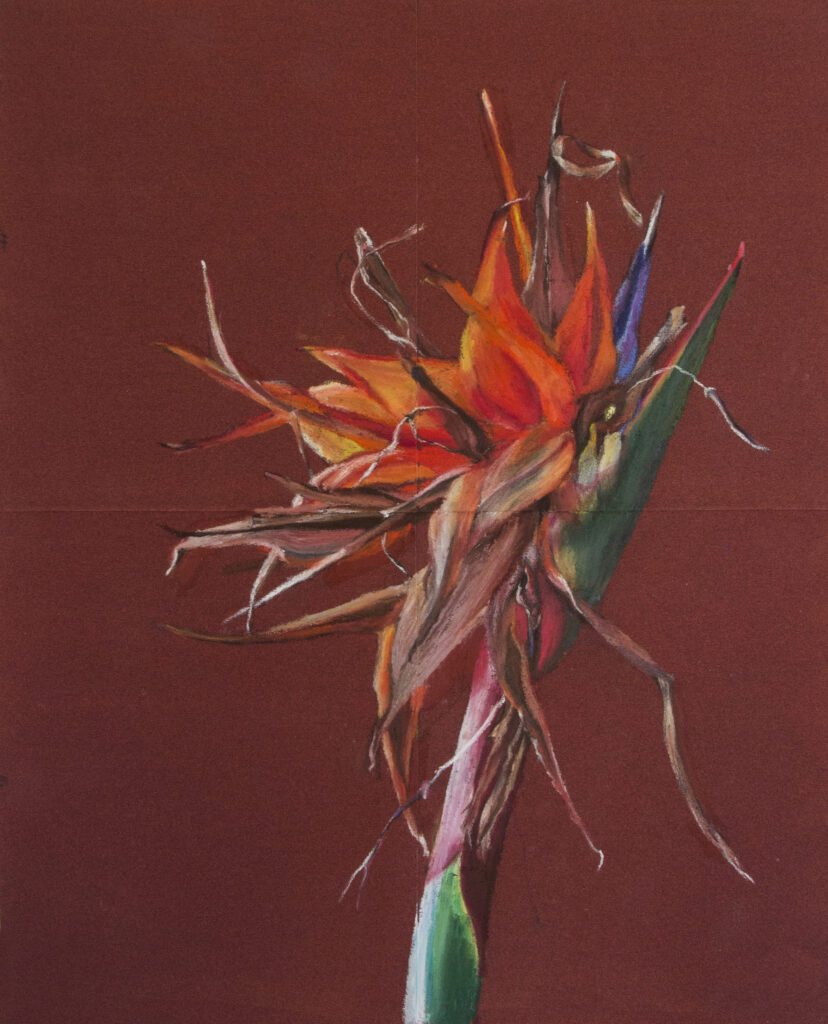
After years working in porcelain, Sharon Brill has stepped into painting with a series that feels both new and deeply connected to her practice. Drawing on rough, colored sandpaper, she creates large-scale flowers that seem to hover between presence and disappearance. These works bring her long-standing interest in natural forces into a more personal space, where gesture, material, and image all carry emotional weight. In this conversation, she speaks about this shift in her work, her relationship to materials, and the personal experiences that have shaped this new body of work.
Until now, your practice has mainly developed through porcelain sculpture, with abstract forms inspired by natural forces — wind, water, geological formations. With this new series, you introduce color, drawing, and a very recognizable image: the flower. Can you tell us about this moment of change?
Sharon Brill: It’s true, for the past 15 years, porcelain has been my primary language. I have been focused on the movement of natural elements—air, water, earth, and fire—and how to give them form through clay. But honestly, painting was always waiting for me in the corner. My very first exhibition, back in high school, was actually of paintings, and over the years I’ve continued to explore color and collage alongside my sculpture. If anything, spending so much time in the monochromatic white world of porcelain only made my “hunger” for color grow.
The flower series actually grew out of my everyday studio materials. For years, I’ve used sandpaper to smooth my sculptures, and from time to time, I felt an urge to draw on it.
The real turning point came during the complex and turbulent days we’ve been experiencing here in Israel. I was looking for a visual way to hold conflicting emotions that exist all at once within the soul. I found that expression in a clash of materials: on one hand, soft oil pastels; on the other, abrasive sandpaper that scratches and stings. The flower emerged almost on its own—a soft, fragile image forced to exist on a rough surface. I feel that the intuitive choices I made in this series draw on the personification of the flower and on ancient archetypes. It allows me to have a dialogue with my “artistic mothers”—those modernist women artists who paved the way before me by using the flower as a complex, multifaceted, and feminist motif.
The use of sandpaper is very striking. It is a difficult and almost hostile surface, and its dark red color evokes something organic (like flesh or blood). What led you to choose this material?
Sharon Brill: Because of my sculptural work, my studio is always stocked with various types of sandpaper in different grits and colors. I was intuitively drawn to the red ones; there was something about the combination of that coarse texture—typically associated with physical, labor-intensive work—and the intensity of the red color that perfectly captured what I was looking for.
This material allowed me to create a fundamental contrast: placing a soft image onto a stubborn, resistant surface. It reflects a state of mind that tries to contain emotional complexity. It gives my “personified” flowers an additional layer of meaning—they are not just flowers; they are bodies existing within a material tension, much like a soul navigating a rough reality.
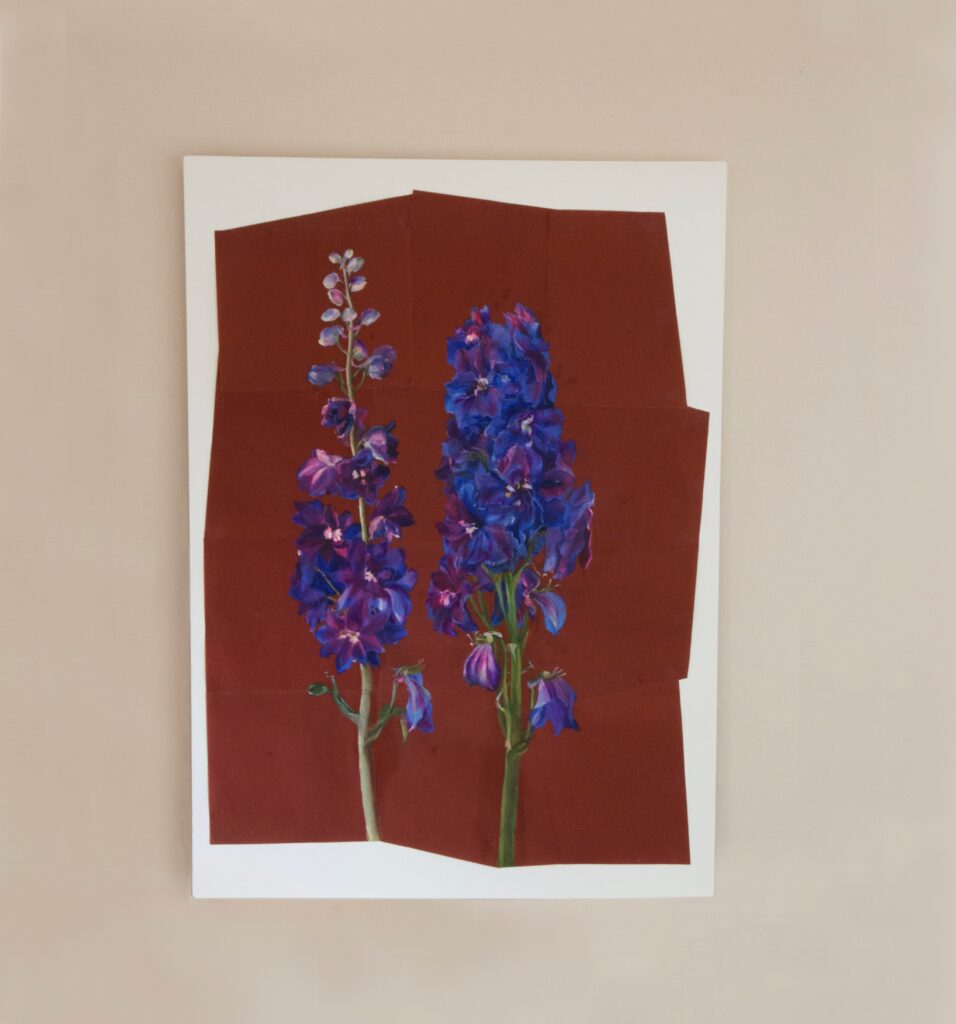
The flower is an image with a long history — from religious symbolism to modern art, and also feminist interpretations today. Are you influenced by this tradition? If yes, is there a specific period or artist that is important for you?
Sharon Brill: While working on this series, I came across the book The Flower Motif in Modernist Women’s Art by Nira Tessler, which explores the evolution of the flower image in art. It opened up a wide landscape for me regarding the flower as a complex metaphorical expression—from its use by the Church to represent the pure and unattainable Virgin Mary, to modern artists like Georgia O’Keeffe and Florine Stettheimer, who transformed it into a bold, feminist motif. I was fascinated by how this single image shifts and evolves across time, gender, and age.
Georgia O’Keeffe, in particular, has been a major influence on me. I felt her presence even in my earlier sculptures, but the most defining moment was during the time I lived in New York, when I visited an exhibition of her work at the Whitney Museum. It was a profoundly moving experience that connected me directly to my “artistic mothers.” I feel that the intuitive choices I’ve made in this series draw on those ancient archetypes and on being part of a long, historical feminine lineage.
At the scale you give them, these flowers have a strong physical presence, almost like a body. Can we see them as “portraits”, or as extensions of the human body?
Sharon Brill: Absolutely. The large scale is intended to create a direct encounter between the viewer and the image. When you stand before a flower that is human-sized—or even taller—it’s hard not to see a reflection of yourself. To me, these are indeed “portraits” through which different states of mind emerge. Sometimes a flower functions as a facial portrait, and other times as a full body captured in a gesture or a moment of communication with another botanical element.
It all starts with observation. I choose the flowers based on the stories they tell me—whether in nature, the garden, or a nursery. I look for the “body language” of the plant, its expression, and wait for a specific emotion or memory to arise within me. Through photography and the use of light, I am able to “direct” their story and sharpen that human-like expression I find in them.
In your text, you mention the idea of feminine maturation. To what extent is this series connected to your personal experience of time, aging, or transformation as a woman?
Sharon Brill: I choose to focus on flowers that are past their peak—capturing moments of wilting, bowing, and collapse. This is a very personal series, a visual and emotional journey into the heart of maturation and change. In a world that sanctifies youth and promotes an often flawless standard of beauty, I found myself standing between my aging parents, my children who have long since left home, and—inevitably—my own reflection in the mirror.
This series explores not only what is lost over time, but also what is revealed because of it. It invites a non-judgmental gaze toward the changing female body and raises questions about aesthetics, meaning, and time. By focusing on the stage of wilting, I want to draw attention to what is not instinctively considered “beautiful,” creating a conversation about cycles of collapse and renewal, and the profound grace that can be found in the process of aging.
In your sculptures, you already explored invisible forces — erosion, pressure, slow transformation. Would you say this series continues these ideas, but in a more intimate and embodied way?
Sharon Brill: That’s true; in my sculptural series, the work was less concrete. I focused on universal natural phenomena that reflected a general state of mind. In porcelain, those invisible forces were more abstract.
This series, however, is much more intimate and embodied. It is concrete, deeply personal, and directly connected to the specific time and place in which I live. While my sculptures dealt with forces acting upon the material from the outside, here the forces—aging, wilting, and the turbulent reality around us—act upon the image from within. Standing before these flowers creates an intensified encounter with life itself. Beyond that, I feel a strong connection to pioneering women artists who explored gender and femininity. I believe we are all part of a single, timeless feminine tapestry, woven together throughout history.
The title Drinking Sorrow in a Cup of Love is very poetic, almost musical. How did this title come to you? Did it come after the works, or during the process?
Sharon Brill: The title is a quote from a song by Yossi Banai, one of Israel’s most esteemed and beloved artists. This phrase accompanied me throughout the entire creative process like an emotional compass; it captures beautifully the ability to hold contradictions—sorrow alongside love—a complexity that has become especially relevant and painful in my country in recent years. Furthermore, the image of the “cup” carries deep cultural and spiritual meanings (such as in Kabbalistic traditions), adding further layers to the connection between the text and the visual imagery.
At this stage, I consider this a working title. It serves as a poetic echo of the emotions emerging in the studio, but I am still searching for a final title that will fully distill the essence of the series. Sometimes the title only reveals itself once the works leave the studio and meet the viewer in the gallery.
With this series, you seem to open a new direction in your practice. Do you see this work as a one-time project, or as the beginning of a new cycle?
Sharon Brill: This question makes me smile and sparks my curiosity. Throughout my years as a sculptor, I have always worked with drawing, photography, and collage. Currently, painting is my main focus, yet I continue to work with ceramics, although with a different intensity. I am fascinated by the discovery of new materials and media and the connections that form between them; some develop into a series that leaves the studio for the world, others wait for their moment, and some remain purely experimental.
I believe in the growth that comes from deep material exploration combined with playfulness and unexpected encounters. I have a strong passion for the creative process and a genuine curiosity about what will come next. And to be honest, there is already something new and exciting in painting developing in my studio right now…