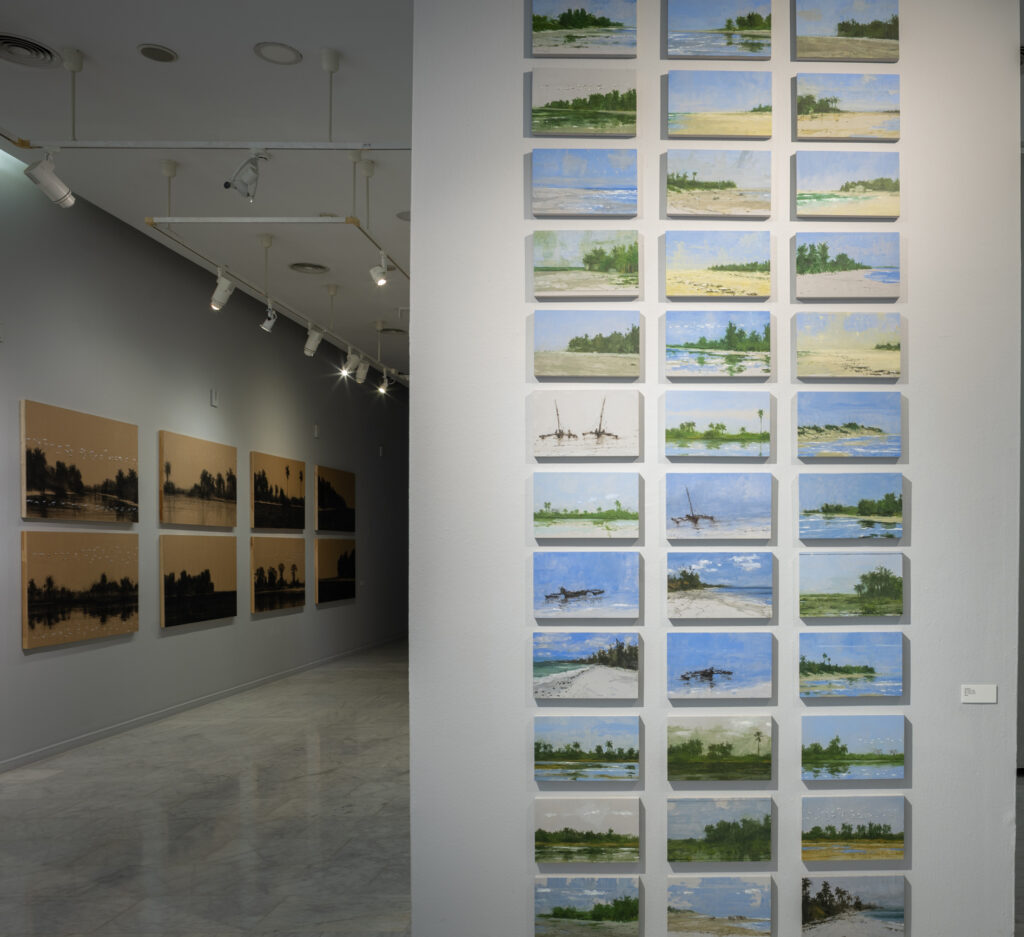
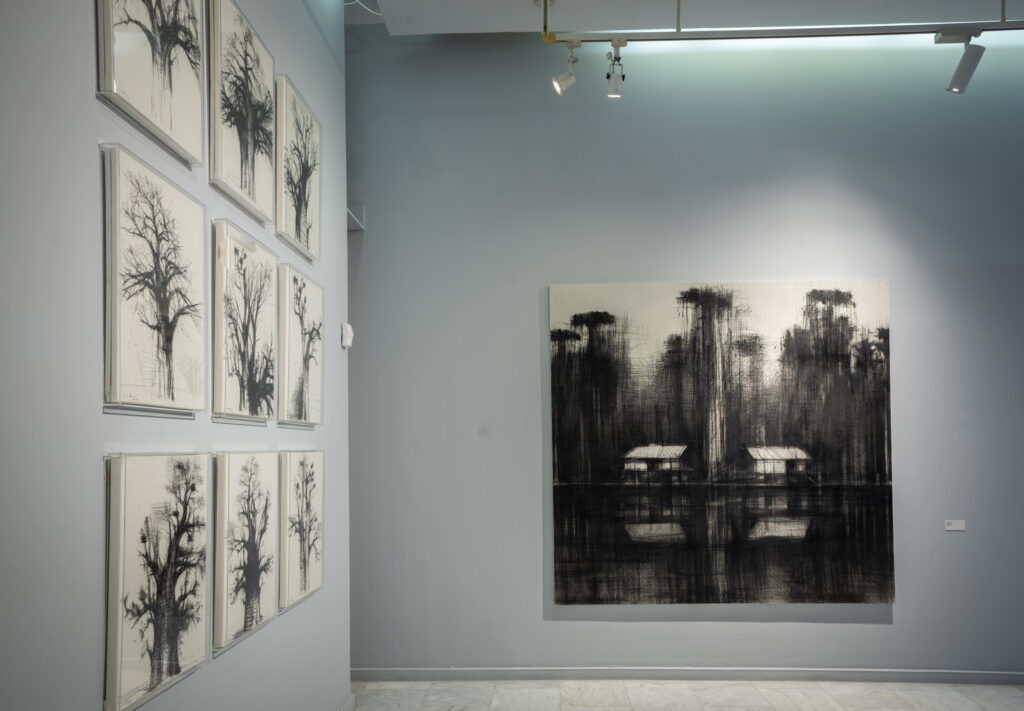
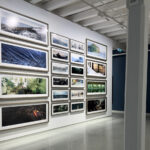
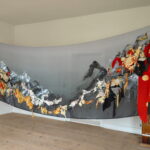
Until 30 August, the Casa de Cultura in Gandia (Spain) is hosting the exhibition ‘Landscape and Climate Change: The Transformation of the Gaze’, curated by Marisa Giménez Soler as part of the 42nd edition of the Gandia Summer University. The exhibition brings together a selection of drawings and paintings by Calo Carratalá, inspired by his travels in Tanzania and Senegal.
Through these landscapes, where human presence is anecdotal but the vulnerability of the natural environment is evident, the artist invites us to reflect on one of the great challenges of our time: climate change.
We reproduce here the text written by José Vicente Cintas about the exhibition.
Because it’s already out of place, and the reason lies over the abyss
The paintings of Torrent native Calo Carratalá present landscapes with Romantic characteristics and stand as an artistic record of historical reflection. The images of natural ruins in these landscapes—without being visionary—reactivate the possibilities explored by Samuel Palmer, John Martin, and John Constable. There is no doubt that it is J. M. W. Turner, specifically, whom Carratalá brings into the present to recover that desire to depict immense, philosophical, and all-too-human epics. Novalis explained that “fantasy places the world either in the heights or in the depths [and that] we dream of journeys through the entire universe: Isn’t the universe within us? We don’t know the depths of our spirit; the path of mystery leads inwards.” Novalis traces a swift historical journey that, with Carratalá, can be slowly outlined as follows.
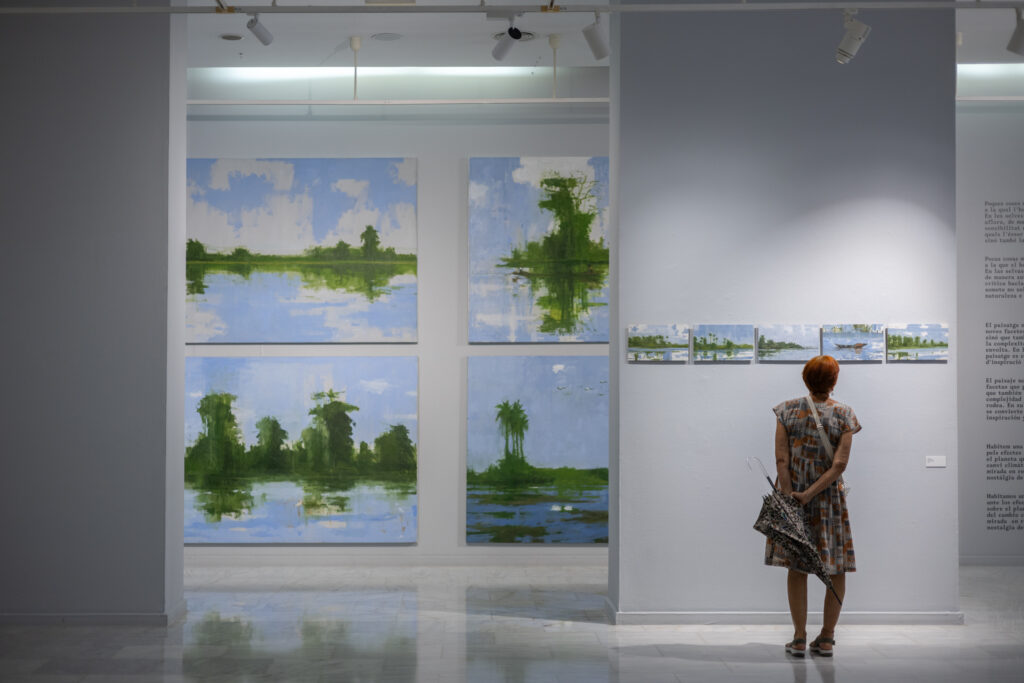
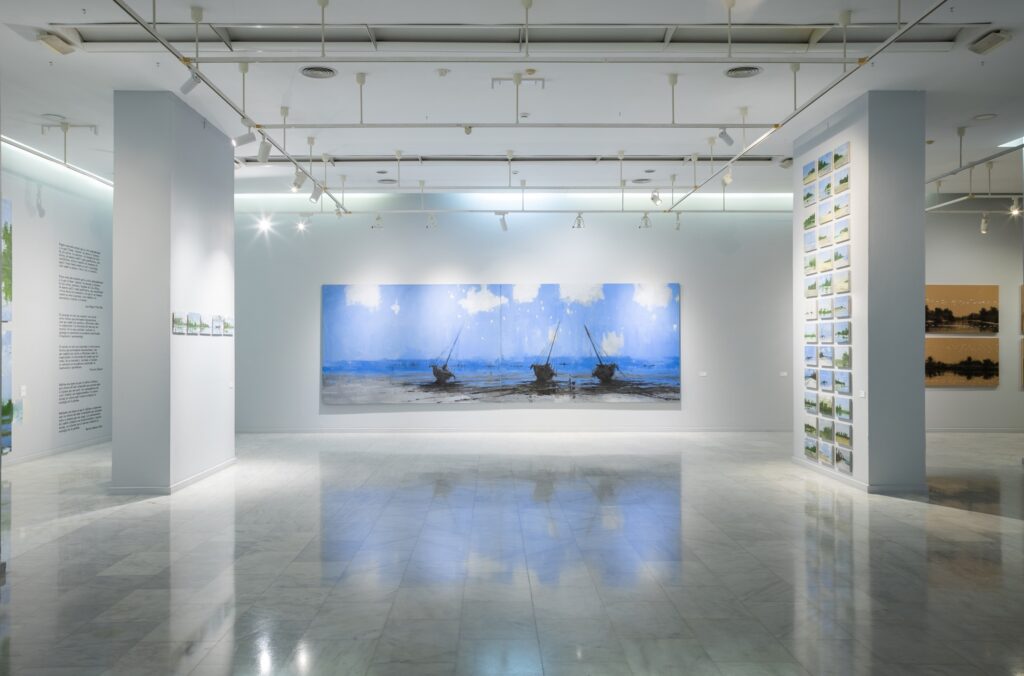
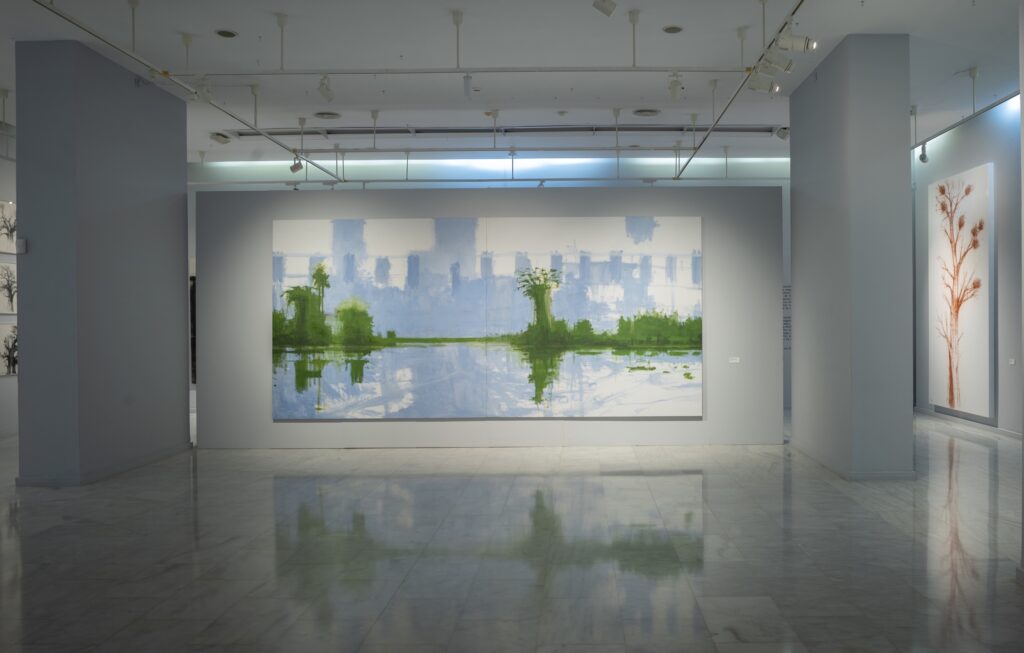
The epicenter of Landscape and Climate Change. The Transformation of Perspective is, this time, in the center of the Exhibition Hall of Gandia’s Cultural Center, precisely at the point equidistant from the paintings 09/02/2023, 17:10h and Barcos de Bagamoyo. These are two large works: the first measures 230 × 496 cm, and the second 200 × 600 cm. The distance between them and the viewer invites contemplation—provided one has the rare chance to find the room empty.
On both sides, the images are divided into two halves by the horizon line, “a vivid and ghostly edge capable of clouding our vision, [it is where] mirages are situated” (Georges Didi-Huberman). The result is that Marisa Giménez Soler’s aptly chosen title for the exhibition is fully realized. The allusion to climate change transcends the inescapable SDGs and urges us to draw the notions of landscape and vision closer together. Gradually, with Novalis and Didi-Huberman, we perceive the phases of Carratalá’s artistic reflection. After rejecting the idea that the landscape is the product of a neutral description, all efforts are directed toward affirming that the landscape is radically a construction—and nothing else. Thus, the point equidistant from the two large paintings loses its firmness, and the slow viewer—one who knows how to take control of time and its rhythm—experiences the dissolution of the environment and finds himself alone with himself. This is the extraordinary transformation brought about by Giménez Soler’s curatorial approach.
The exhibition offers an intellectual opportunity to recognize—perhaps just in time, perhaps too late—the mimesis between nature and subjectivity: what happens to the landscape happens simultaneously to the contemporary subject. This is because, at the most basic level, the human being is already a knot of nature and culture. The defeat of one is also the devastation of the other. The tranquil passage extends from the instant named in the first painting—to declare that time is the duration that drags on within things and gives them their appearance—to the space depicted in the second. The outcome is that any capacity for reasoning beyond this ultimately hangs on some unknown certainty over a dizzying abyss.
Behind the mist and highlights of 02/09/2023, 17:10h, a ferocious urbanization emerges—tall buildings that could be made of cement, iron, and glass, threaded with power lines, pipes, and a thousand types of wood from felled trees. By contrast, aside from the African location of Barcos de Bagamoyo, its six-meter frame emphasizes depopulation and the absence of any human heartbeat. In these paintings, there are no beating hearts. Nature distrusts human beings (Gonçalo M. Tavares) and their extreme lack of biophilia (Edward O. Wilson). These places have rejected humanity, leaving it out of place. Barcos de Bagamoyo is often seen as an emptied Joaquín Sorolla seascape. Nature’s fatigue—following its anger with humans—has swept away all hope. The works, in their varying dimensions, are images of absence and of all that can no longer be what it once was. It falls to the viewer to recognize the lack of temporal and spatial grounding. Almost nothing remains relevant. Reason sinks into the abyss.
In its furious farewell, nature announces a dystopia. Were human beings to bare their hearts, they might admit that Baudelaire’s poetic clairvoyance will never again be possible: “Those who know how to observe themselves and then remember their impressions […] as soon as the sleep that sealed them is lifted from their eyelids, the outside world presents itself to them in powerful relief, with a sharpness of contours and a richness of admirable colors.” Stopping to see in this way has become imperative, as has ending the harmful “infantile omnipotence” of so many empty adults (Christopher Lasch). In any case, there is a factor influencing climate change and the transformation of our perspective that, until now, has been mentioned only in passing: construction—specifically, urban planning—which corrupts nature. Construction feeds and enriches itself through the destruction of the natural landscape. And on prices. It is entirely strange. We might take another step by returning to Novalis’s initial question: “Isn’t the universe within us?” And what kind of universe is each one?
A brief coda. A small table and a low chair are placed at the equidistant point, allowing one to contemplate Carratalá’s paintings, write about them, and read. Read what? Alongside Carratalá and the tòpic of urban devastation, the closest affinity lies in the works of Rafael Chirbes (1949–2015), a writer from Tavernes de la Valldigna. He and Marta Sanz wrote prologues for each other. Now, tacitly intertwined, they accompany certain readings of Carratalá’s paintings. It could have been On the Edge, but to go further, it is Crematorio:
“All the calm of the Mediterranean the brochures for their real estate developments offer buyers, in which you inevitably see few buildings and lots of green and blue; all the light of the Mediterranean and all the luxury of the Mediterranean, and all the blue, and all the sun, whatever, but always with the whole thing in front and the Mediterranean behind. All the green, all the blue, all the sky, all the salt water. As if the buyer were going to buy the entire bathtub, from Algeciras to Istanbul, and the heating system with its gadgets (sun, moon and stars) in full. The ultimate happiness package. The photos of the developments resemble each other like Siamese twins, like newly cloned dolls: palm trees, a golf course with distant white figurines squashed against the grass, a few generously crowned pines, and, behind them, the sea.”
José Vicente Cintas
“Paisaje y cambio climático. La transformación de la mirada” (Landscape and climate change. The transformation of the gaze). Works by Calo Carratalá
Casa de Cultura Marqués de González de Quirós
Pg. de les Germanies, 11 – Gandia, Spain